



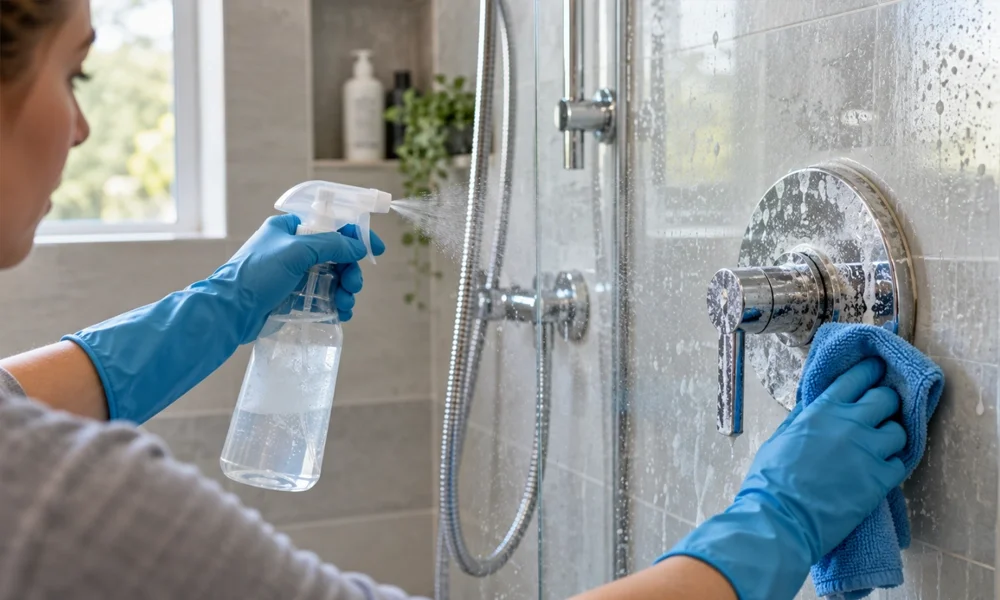

Your glass shower door was crystal clear the day you moved in. Now it looks like someone breathed on it in 2019 and the fog never left. You’ve scrubbed. You’ve bought the spray with the confident label. You’ve said things to a faucet you would never say at an HOA meeting.
Here’s the part nobody tells you: you’re probably not a bad cleaner. You’re fighting the water. Much of Hamilton County runs on very hard tap water, and every drop that dries on your faucet leaves a tiny souvenir of Indiana limestone behind.
The good news? Learning how to remove hard water stains is mostly chemistry, not muscle. The right acid on the right surface does the work for you. The wrong one can etch a marble vanity in minutes. This guide covers both.
IN THIS POST YOU’LL LEARN:
How Do You Remove Hard Water Stains?
Why Hard Water Stains Are Worse in Carmel, Fishers, and Westfield
Is It Hard Water, Soap Scum, or Something Else?
How to Remove Hard Water Stains, Surface by Surface
The Vinegar and Baking Soda Myth
How Do You Remove Hard Water Stains?
Dissolve them instead of scrubbing them. Spray undiluted white vinegar (or a citric acid cleaner) on the stain, keep it wet for 10 to 15 minutes, scrub with a non-scratch pad, rinse, and dry the surface completely. On faucets, wrap the area in a vinegar-soaked paper towel so the acid stays put. Old buildup may need two or three rounds. One hard rule: never use vinegar or any acid on marble, limestone, travertine, or unsealed granite. Those stones are made of the same mineral you’re trying to dissolve.
Why Hard Water Stains Are Worse in Carmel, Fishers, and Westfield
The U.S. Geological Survey calls anything over 180 milligrams per liter of calcium carbonate “very hard.” According to the Citizens Energy Group water quality report, the utility’s water averages about 320 milligrams per liter, or 19 grains per gallon. That’s roughly 1.8 times the “very hard” line. Citizens serves much of Fishers and Westfield, so whether you live in Saxony, Britton Falls, or near Grand Park, your shower glass is taking a daily mineral bath.
Carmel is a little different. Carmel Utilities softens city water at its treatment plants to roughly eight grains. Two catches, though. The utility may soften less during peak summer demand, which is exactly when the Village of West Clay is running every sprinkler it owns. And some Carmel addresses are served by Citizens instead, with unsoftened water. Your water bill tells you which one you have.
One reassuring fact: the USGS notes that the EPA sets no health limit for hardness, because calcium and magnesium aren’t harmful to drink. Hard water is a cleaning problem, not a health problem.
Is It Hard Water, Soap Scum, or Something Else?
Half the frustration with hard water stains comes from treating the wrong stain with the wrong cleaner. Check what you’re looking at first.
| What you see | What it probably is | What removes it |
|---|---|---|
| Chalky white spots or crust, gritty to the touch | Hard water minerals (calcium carbonate) | Acid: white vinegar, citric acid, or a descaler |
| Dull gray film that feels slick or waxy | Soap scum (soap bonded with calcium) | Dish soap to degrease, then acid |
| Orange or rusty brown streaks | Iron deposits | A rust remover made for that surface |
| Pink or orange slime in corners and drains | Airborne bacteria, not minerals | Regular cleaning, drying, and ventilation |
Quick test: dab a little vinegar on the spot. If it fizzes slightly or softens within a few minutes, it’s mineral. If nothing happens, more scrubbing won’t change that.
How to Remove Hard Water Stains, Surface by Surface
Every surface in your house has a different tolerance for acid. Start with the one everyone asks about.
Glass shower doors
- Rinse the glass with warm water.
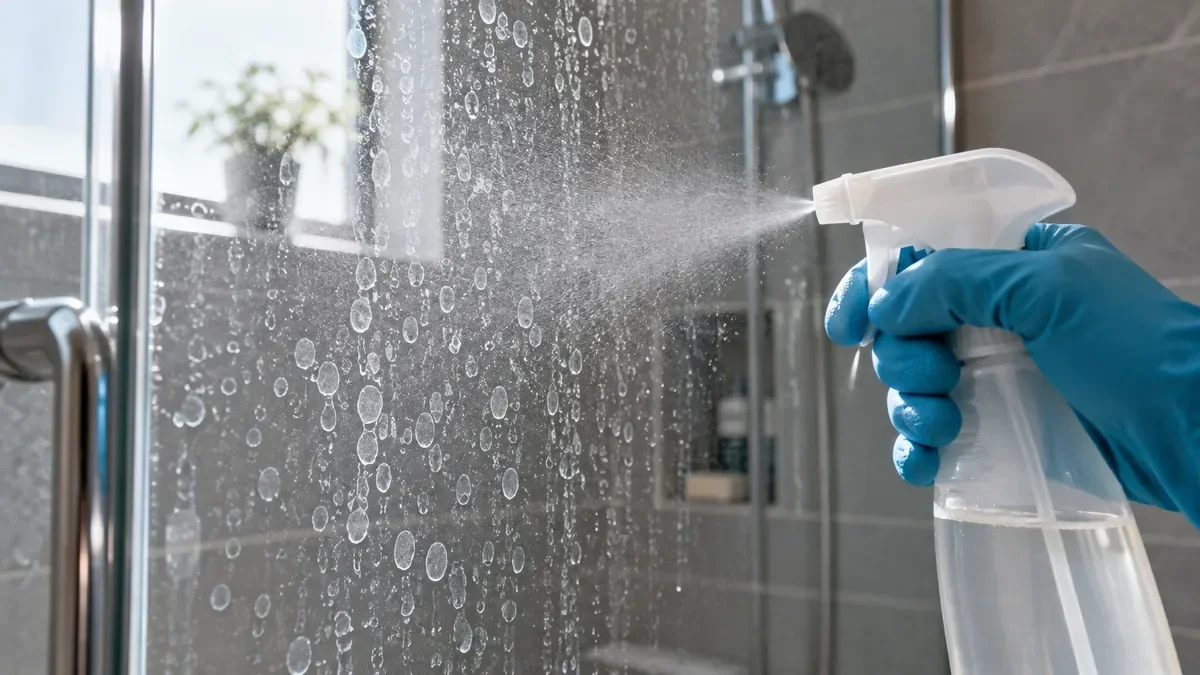
- Spray undiluted white vinegar until the glass is fully wet. Warm vinegar works faster.
- Let it sit 10 to 15 minutes. Respray if it starts drying, because dry vinegar does nothing.
- Scrub with a non-scratch sponge, or a baking soda paste for stubborn spots.
- Rinse, squeegee, and buff dry with microfiber.
Still cloudy? Run a fingernail across the glass. Gritty means more mineral to remove. Smooth but hazy means the glass itself is etched, and no cleaner fixes that.
Toilet bowl rings
Pour about two cups of white vinegar into the bowl so it covers the ring, leave it overnight, and scrub in the morning. For a ring older than your mortgage, a wet pumice stone removes it from porcelain without scratching. Keep both the stone and the bowl wet, and never use pumice on plastic seats.
Safety note: never combine vinegar with a bleach-based toilet cleaner. Acid and bleach together release chlorine gas.
Faucets, showerheads, and stainless steel
Wrap faucet bases in a vinegar-soaked paper towel. For showerheads, fill a plastic bag with vinegar, slip it over the head, and secure it with a rubber band for 30 to 60 minutes. Drop unscrewed aerators in a cup of vinegar. On stainless sinks, spray a 50/50 vinegar and water mix, wait five minutes, and wipe with the grain.
Matte black, brushed gold, and oil-rubbed bronze finishes can dull with long acid contact. Check the manufacturer’s care guide, dilute, and keep it short.
Granite, marble, and quartz: the do-not-vinegar zone
Marble, limestone, and travertine are calcium carbonate. Acid can’t tell the stain from the countertop, so it eats both and leaves a dull spot called an etch. Repeated acid also breaks down granite sealer. Use a pH-neutral stone cleaner and a soft cloth, and lift light film with a plastic scraper held flat. Quartz care rules come from the manufacturer, and most say mild soap only.
Tile and grout
Glazed ceramic and porcelain tile handle vinegar fine. Cement-based grout doesn’t love it. Use diluted vinegar, limit contact to a few minutes, and rinse well.
The Vinegar and Baking Soda Myth
Every cleaning video wants you to pour vinegar onto baking soda and watch it fizz. It looks powerful. It mostly isn’t.
Nathan Kilah, a senior lecturer in chemistry at the University of Tasmania, broke down the reaction in The Conversation. The acid and base neutralize each other into water, carbon dioxide, and sodium acetate, a weak cleaner. He called the fizz essentially a visual “placebo.” In a typical baking-soda-heavy DIY recipe, he calculated that over 99 percent of the baking soda remains after the bubbles stop.
He also confirmed the part that matters here: vinegar’s acid reacts with and dissolves limescale, which is why it works on showers and kettles.
So use vinegar alone to dissolve minerals. Use baking soda alone as a gentle scrub. If you need both, apply them one after the other.
How to Keep Hard Water Stains From Coming Back
Prevention comes down to one idea: water that doesn’t sit can’t leave minerals behind.
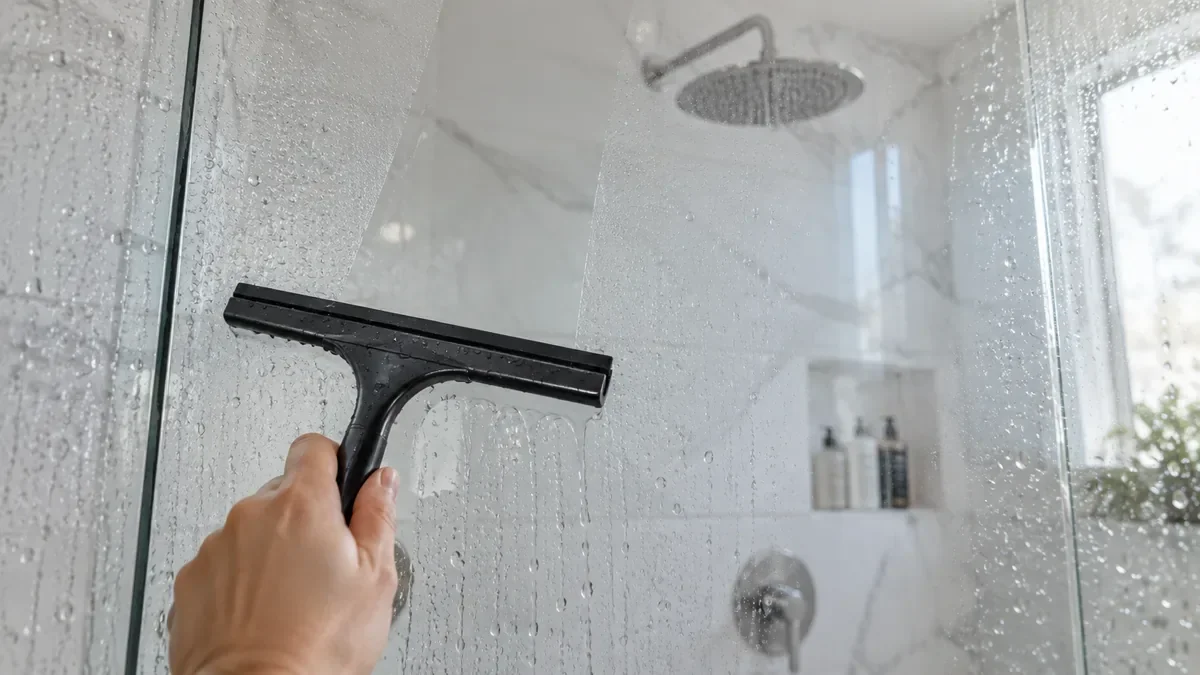
After every shower: squeegee the glass and tile. About 10 seconds, which is less time than finding your phone.
Every day: wipe faucets dry with a microfiber cloth. Keep one hanging by each sink so it actually happens.
Every week: spray a 50/50 vinegar solution on glass and fixtures. Thin film dissolves in a minute. Thick crust takes an afternoon.
Every month: soak showerheads and aerators, and run an empty dishwasher cycle with a cup of vinegar on the top rack.
Long term: a whole-house water softener stops minerals at the source. Most shower filters target chlorine, not calcium, so read the specs before expecting miracles. And a softener prevents new stains. It doesn’t erase old ones.
Run the bathroom fan 20 minutes after showers, too. In an Indiana winter, nobody is cracking a window.
When DIY Stops Working
If three rounds of vinegar haven’t touched it, a commercial descaler is the next step. Wear gloves, ventilate, and test a hidden spot first.
If the surface is smooth but permanently cloudy, it’s etched. That happens when deposits sit for months or years, and only a glass or stone restoration specialist can polish it out.
This is where routine cleaning earns its keep. Film that gets wiped every week or two never hardens into crust. Original fixtures in Old Town Carmel and brand-new ones in Fishers face the same water. The difference between shiny and foggy is usually how often someone gets to it.
About MaidThis Cleaning of Carmel-Fishers

If your Saturday plans involve the Monon Trail more than the shower door, MaidThis Cleaning of Carmel-Fishers can take the bathroom off your list. Background-checked, bonded cleaners provide house cleaning services across Carmel, Fishers, Westfield, Noblesville, Zionsville, and nearby Hamilton County.
Every cleaner passes a 5-step screening process. Pricing is upfront, starting at $97, and you’re billed after the job.
- A bathroom cleaning service that covers glass, fixtures, tubs, and toilets
- A one-time deep cleaning to reset heavy buildup
- Weekly or biweekly visits that keep film from turning into crust
- The 24-Hour Happiness Guarantee and the Never a No-Show Guarantee
Just moved? Pair this guide with the move-in cleaning checklist. Mention heavy buildup or natural stone when you book so the team plans the right products and time. Eco-friendly products are available on request.