


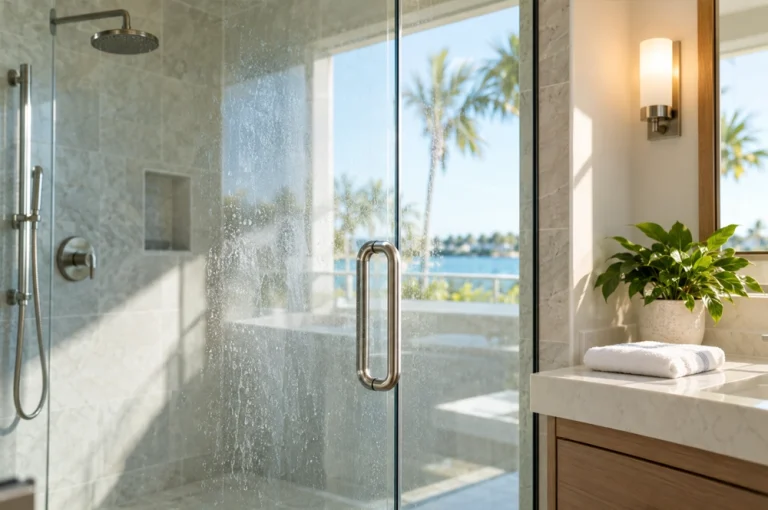

Every bathroom in North Palm Beach has a shower door that used to be clear. You remember it. Crisp, practically invisible, the kind of glass that made guests check whether there was a door at all. Now it looks like someone fogged it up in 2019 and the fog decided to stay.
That cloud is usually mineral crust, and learning how to remove hard water stains really comes down to two decisions: which acid, and which surface. Pair them correctly and the spots wipe off in minutes. Pair them badly and you swap a white haze for a permanent dull patch on a marble vanity that cost more than your first car.
There’s a local twist, too. Most of North Palm Beach drinks membrane-filtered water, which is not what the average hard water article assumes. So some of the spots you’re blaming on the tap came from the sprinklers. Some blew in off the Atlantic. A few are plain soap scum in a convincing costume.
Grab a spray bottle. Leave the steel wool in the garage.

What’s the fastest way to remove hard water stains?
Dissolve them with a mild acid, give the acid time to work, then rinse and dry. On glass, chrome, porcelain, and glazed ceramic tile, this sequence clears most white mineral spots:
- Rinse the surface with warm water to knock off loose soap film.
- Spray undiluted white distilled vinegar (about 5% acetic acid) until every spot is soaked.
- Wait 10 to 15 minutes. On vertical glass, press vinegar-soaked paper towels against the worst areas so the acid stays put instead of sliding into the drain.
- Scrub with a non-scratch sponge or a soft nylon brush. For leftover haze, dust a little baking soda on the damp sponge and make one more pass.
- Rinse with clean water.
- Dry everything with a microfiber cloth or squeegee. Skip this and fresh spots form while you’re admiring the old ones being gone.
One rule overrides the whole list: no vinegar, lemon juice, or acidic cleaners on marble, travertine, limestone, or terrazzo. Those stones are mostly calcium carbonate, the same material you’re trying to dissolve, and the acid can’t tell the difference. (Stone gets its own section below.)
Does North Palm Beach have hard water? It depends on your street
Florida’s reputation for hard water is earned at the source. The aquifers under Palm Beach County sit in limestone, and groundwater moving through limestone collects calcium and magnesium along the way. What comes out of your faucet, though, depends on which plant treated it first.
North Palm Beach, Palm Beach Gardens, Lake Park, and southern Juno Beach
These communities get their water from Seacoast Utility Authority, which serves roughly 56,000 homes and businesses in northern Palm Beach County. According to Seacoast’s 2025 Annual Water Quality Report, its Hood Road plant runs on membranes: 26 million gallons a day of nanofiltration, which the utility describes as demineralization, plus 3.5 million gallons of reverse osmosis. Translation? Much of the mineral load is filtered out before the water ever reaches Old Port Cove or PGA National.
That doesn’t make your shower spot-proof. Any water that evaporates leaves something behind, and a thin mineral film mixed with soap, shampoo, and body oil still builds a crust over a few months. It just builds slower than it would in Phoenix.
Singer Island and Riviera Beach
The City of Riviera Beach Utility Special District operates a lime-softening plant fed by 27 wells in the surficial aquifer. Lime softening lowers hardness through chemistry rather than membranes, so the water behaves differently. If you split time between a Singer Island condo and a house in the Gardens, don’t be surprised when one cleaning routine works great in one bathroom and struggles in the other.
Jupiter
Jupiter Utilities pairs reverse osmosis with nanofiltration, a membrane system the town has been building on since 1990. Like Seacoast water, it starts out low in the minerals that cause crust.
The sprinklers are the sneaky culprit
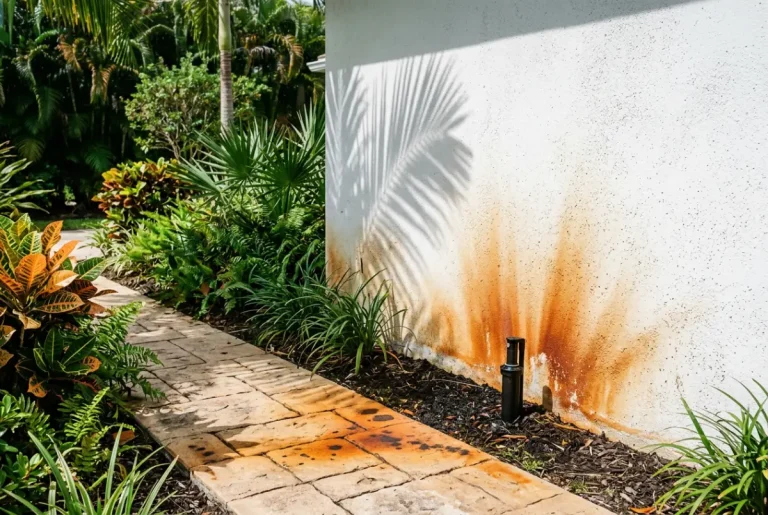
New residents rarely see this one coming. Plenty of South Florida homes water the lawn from a private shallow well instead of the utility line, and that water skips treatment entirely. The University of Florida IFAS Florida-Friendly Landscaping program puts it plainly: “most Florida well water is high in iron.” When sprinkler heads overspray onto stucco, pavers, the pool cage, or the bottom of a sliding glass door, that iron oxidizes into orange and brown streaks. Those are rust stains, and vinegar barely dents them.
On the water side of the house: salt
Ocean-facing windows on Singer Island and along the Intracoastal collect a gritty white film that looks a lot like hard water spotting. Often it’s dried salt spray. Warm water, a drop of dish soap, and a squeegee usually clear it, no acid required. For the bigger picture on salt air, see this guide to how living near the ocean affects your North Palm Beach home.
Want a number for your own tap? An inexpensive hardware-store test strip gives a reading in about a minute. Under roughly 60 mg/L (3.5 grains per gallon) counts as soft to slightly hard on the U.S. Geological Survey scale. Over 120 mg/L is hard.
Identify the stain before you scrub
Treating every mark as hard water is how people spend forty minutes scrubbing rust with vinegar and then blame their elbows. Match the mark to its cause first:
| What you see | What it usually is | What removes it |
|---|---|---|
| Chalky white spots or crusty rings on glass, chrome, and faucets | Mineral deposits (calcium and magnesium) | White vinegar or a citric acid cleaner, dwell time, rinse, dry |
| Cloudy gray film on shower doors and tile that feels slightly greasy | Soap scum bonded with minerals | Dish soap first to cut the oils, then vinegar |
| Orange or reddish-brown streaks on walls, pavers, tubs, or toilets | Iron from irrigation well water or old pipes | An oxalic acid cleaner or rust remover labeled for that surface |
| Whitish, gritty haze on ocean-side windows and railings | Dried salt spray | Warm water, a drop of dish soap, squeegee |
| Dull, lighter patches on marble or travertine that won’t wipe off | Etching, which is surface damage, not a stain | Professional honing or polishing; no cleaner fixes it |
| Black or green dots in grout and caulk | Mildew | A mildew job, not a mineral job |
A quick check for white spots on glass or chrome: dab on a little vinegar and wait a minute. If the spot softens or fades, it’s mineral. If nothing changes, you’re likely looking at soap film or glass that’s already etched. (Don’t run this test on stone. See above, and below, and basically everywhere.)
How to remove hard water stains, surface by surface
Same chemistry, different rules. What works on a porcelain toilet will quietly ruin a honed travertine floor, so go one surface at a time.
Glass shower doors
- Mix equal parts warm white vinegar and water in a spray bottle with a teaspoon of dish soap. The soap helps the solution cling and cuts the body oil that glues minerals to glass.
- Spray, wait 15 minutes, scrub with a non-scratch pad, rinse, and squeegee dry.
- For thick, older buildup, make a paste of baking soda and a splash of vinegar, work it in with a damp sponge, and rinse well.
- A razor scraper held almost flat on wet glass can lift stubborn crust, but check first. Many frameless doors leave the factory with a protective coating, and a blade or abrasive pad can strip it. Textured and tinted glass shouldn’t be scraped at all.
Faucets, shower heads, and fixtures
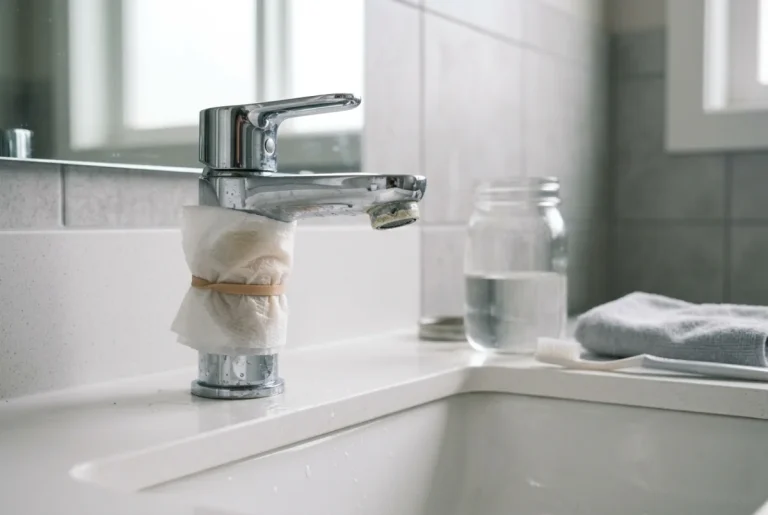
Wrap a vinegar-soaked paper towel around the faucet base or spout and hold it in place with a rubber band for 30 to 60 minutes. For a shower head, fill a zip-top bag with vinegar, tie it around the head so the nozzles sit submerged, and leave it for about an hour. Scrub the nozzles and aerator with an old toothbrush, then run hot water through.
Check the finish before you soak. Polished chrome handles vinegar well. Unlacquered brass, oil-rubbed bronze, matte black, and gold-tone finishes can discolor, so test a hidden spot or use a cleaner the manufacturer approves.
Toilet bowl rings
Turn off the supply valve behind the toilet and flush to drain the bowl so the cleaner isn’t diluted. Pour in vinegar or apply a descaling gel, let it sit for a few hours, then scrub. For a ring that won’t move, a wet pumice stone used gently on porcelain can grind it off. An orange ring is iron, not calcium, so reach for a rust remover instead.
Ceramic and porcelain tile, plus grout
Glazed tile tolerates a 1:1 vinegar and water spray just fine. Grout is touchier. Most grout is cement-based, and repeated acid contact wears it down over time, so keep vinegar on grout lines brief, rinse thoroughly, and reseal grout once a year in busy showers.
Stainless steel sinks
Spread a paste of baking soda and water over the spots, wipe with a vinegar-dampened cloth, and rub in the direction of the grain. Rinse and dry with a soft towel. That last dry is what keeps a kitchen sink in Lost Tree Village looking like the listing photos.
Marble, travertine, limestone, and terrazzo
Here’s where good intentions do the most damage. Fred Hueston, a stone restoration expert and president of Stone Forensics, says it as directly as anyone can: “You never want to clean natural stone with vinegar.” The acid reacts with the calcium in the stone and leaves an etch mark, a dull spot that looks like a stain but is actually missing polish.
Instead, clean natural stone with a pH-neutral stone cleaner and a soft cloth. For mineral crust on a stone shower, use a hard water remover specifically labeled safe for natural stone, follow the dwell time exactly, and rinse well. If you still see dull, slightly rough patches after cleaning, that’s etching. A stone restoration company can hone and repolish it. A spray bottle can’t.
This matters more here than in most towns. Marble baths and terrazzo floors are everywhere from Admirals Cove to the older ranch homes along U.S. 1.
Granite and quartz countertops
Sealed granite is tougher than marble, but repeated acid can still dull the sealer, so a stone-safe cleaner is the safer daily choice. Quartz handles most mild cleaners, though many manufacturers warn against harsh chemicals and abrasive pads. When in doubt, check the care sheet your fabricator left behind. (It’s probably in the drawer with the takeout menus.)
How to keep hard water stains from coming back
Removing spots is a weekend project. Preventing them is about thirty seconds a day. A few habits do most of the work:
- Squeegee the shower glass after every shower. It takes less time than finding a towel.
- Keep a spray bottle of half vinegar, half water for chrome and glass (never stone) and mist the fixtures once a week.
- Wipe faucets dry after heavy use, especially in guest baths that see a week of traffic and then sit.
- Apply a water-repellent glass treatment to shower doors every few months so water beads up and runs off.
- Switch from bar soap to liquid body wash. Bar soap leaves more of the waxy residue that minerals stick to.
- Aim sprinkler heads away from walls, windows, and the pool cage, and ask your irrigation company about a rust inhibitor if you water from a well.
- Rinse ocean-side windows and railings with fresh water after windy weeks.
- Test your water before buying a whole-home softener. If you’re on Seacoast’s membrane-treated water, a good squeegee may do more for your shower than a system that costs thousands.
When the stain won’t budge (and who to call)
Mineral deposits left alone for years can etch glass. The minerals bond with the surface and leave microscopic pits, and no cleaner reverses that. The giveaway? If the haze is still visible when the glass is wet and freshly cleaned, the glass itself is damaged. Glass restoration specialists can polish out light etching. Heavy etching usually means new glass.
Same logic for stone. A dull mark on marble that feels slightly rough under your fingertip is etching, and that’s a job for a stone restoration pro. Rust on exterior stucco and pavers may call for a pressure washing or rust removal company.
Everything else, the routine buildup and the slow creep of crust on fixtures, is maintenance. And maintenance has a way of losing to tee times, grandkids visiting for the holidays, and a boat that won’t wash itself.

MaidThis Cleaning of North Palm Beach cleans homes and condos across North Palm Beach, Singer Island, Palm Beach Gardens, Juno Beach, Jupiter, and Tequesta. Shower glass, faucets, fixtures, tubs, and tile get attention on every bathroom visit. Flag marble, travertine, or terrazzo when you book so it gets a stone-safe cleaner instead of anything acidic. Every cleaner passes a five-step screening process, English- and Spanish-speaking cleaners are available, and eco-friendly products can be requested ahead of your visit.
Regular bathroom cleaning in North Palm Beach keeps mineral film from ever hardening into crust, with shower glass, fixtures, and tile handled on every visit. If your sink and backsplash need the same attention, add kitchen cleaning. Facing years of buildup? Start with a deep cleaning service to reset everything, then keep it there with recurring visits.
Snowbird season is filling the calendar fast. Book now and walk into a shower you can actually see through.