



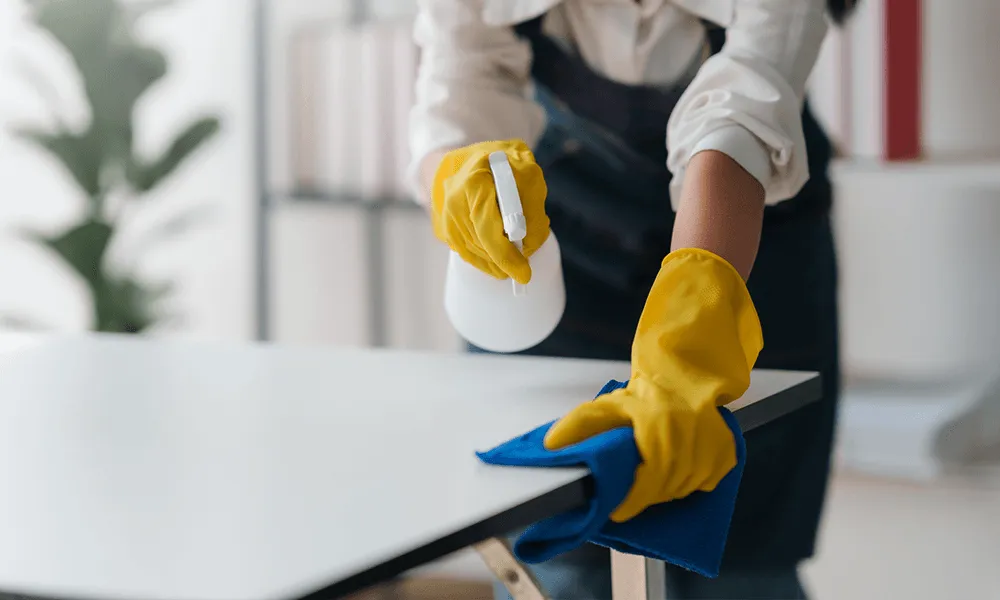

Somewhere in your office right now, there is a coffee mug that has not been washed since the Obama administration. There’s a keyboard with enough crumbs to sustain a small bird. And there’s a shared microwave door handle that everyone touches, nobody cleans, and somehow still surprises people when flu season rolls through the building like a bad cover band.
None of this happens because your team is gross. It happens because nobody wrote anything down. “Keep the office clean” is a wish, not a plan. An office cleaning checklist is the plan: what gets cleaned, how often, by whom, and what “done” looks like. This one is built for Durham businesses, which means it accounts for pollen season, red clay, and old tobacco warehouses with ledges you cannot see from the floor.
Key Takeaways
- A working office cleaning checklist has four layers: daily high-touch surfaces, weekly floors and glass, monthly deep tasks, and a name next to each one
- The germiest surfaces in an office are the ones that look clean (phones, keyboards, coffee pot handles), not the ones that look dirty
- Durham offices need seasonal add-ons that national templates skip: pollen protocols in spring, mildew checks in summer, and red clay defense at every entrance year-round
- The checklist is also your scope of work if you hire a cleaning service, so write it like a contract, not a suggestion
Why does a Durham office need its own cleaning checklist?
Because the Triangle throws problems at buildings that a generic template does not anticipate. A checklist written for a climate-controlled office park in Phoenix has no line for “wipe yellow pine pollen off every horizontal surface in April.” Yours should. Durham has humid summers, clay soil, and a downtown full of century-old brick buildings converted into office space. Each of those adds tasks. The rest of this post walks through the standard layers first, then the local additions.
The daily office cleaning list
Daily tasks are the ones with the shortest fuse. Skip them for a week and the office starts to smell like a gym bag with a business license.
Every business day, someone should handle:
- Wiping desks, keyboards, mice, and desk phones with a disinfectant wipe
- Wiping door handles, light switches, elevator buttons, and stair rails
- Cleaning break room counters, the sink, the coffee station, and the microwave handle
- Emptying trash and recycling and replacing liners
- Restocking restrooms and wiping sinks, faucet handles, and toilet flush levers
- Checking the entryway and mats, especially after rain
That’s a ten to fifteen minute job in a small office. For a suite with 20 or more people and a full kitchen, it’s closer to an hour, which is usually the point where businesses look into recurring office cleaning services in Durham instead of asking the newest hire to “keep an eye on things.”
Weekly, monthly, quarterly: the stuff that piles up quietly

Weekly is mostly floors and glass. Vacuum carpets and rugs. Mop hard floors. Clean interior glass, partitions, and the front door. Wipe down chairs (armrests especially), dust shelves and windowsills, and clean the tops of filing cabinets where a fine grey fuzz has been forming since the last time anyone looked up there. Clear the fridge of anything unlabeled or unloved.
Monthly tasks catch what makes a space feel stale. Dust ceiling vents and return grilles. Vacuum upholstered chairs and any fabric partitions. Wipe baseboards. Clean the walls around light switches and behind trash cans. Deep-clean the inside of the microwave and the coffee maker. Look under desks for the cable-and-crumb habitat that forms there.
Quarterly, add carpet cleaning, exterior windows if you’re on the ground floor, and a supply closet reset so the cleaning products your checklist assumes you have are actually there.
Office sanitation: the surfaces that look fine are the problem
Dr. Kelly Reynolds, a public health professor and environmental microbiologist at the University of Arizona, ran a study in which one person in an office of about 80 people unknowingly started the day with a harmless tracer virus on their hands. Within about four hours, more than half of the commonly touched surfaces in the office, and more than half of the people, had picked it up. Reynolds said afterward, “We were actually quite surprised by how effectively everything spread.” The hot spots were the coffee pot handle, phones, desktops, tabletops, doorknobs, and copy machine buttons.
Notice what’s not on that list. Nobody caught anything from the toilet seat. Toilets get cleaned because they look like they need it. Coffee pot handles do not.
The same study found that basic interventions, like hand washing, sanitizer, and disinfecting wipes on shared surfaces, cut the spread dramatically. So an office sanitation plan does not require anything heroic. It requires consistency on the right surfaces.
One distinction matters here. Cleaning removes dirt and lowers the number of germs. Disinfecting kills what’s left, and it only works if the product stays wet on the surface for the contact time on its label. The CDC’s guidance on cleaning and disinfecting lays this out in plain terms. Spraying and wiping in one motion is a nice ritual, but it’s not disinfecting.
Durham-specific lines your office cleaning checklist should include

This is the section a downloaded template will never have.
Pollen season (mid-March through April)
Every spring, the Triangle turns yellow. Pine pollen rides in on shoes, jackets, and the breeze every time the front door opens, and it settles on every flat surface in the building. During those weeks, bump dusting and entry-mat cleaning from weekly to every other day, and clean interior glass twice as often. Offices near Duke Forest and along Erwin Road get it worst. It will not stop the pollen. It will stop your reception desk from looking like it was breaded.
Summer humidity
Durham summers are muggy, and break rooms with weak airflow are where it shows. From June through September, add a biweekly check inside the fridge door seal, under the sink, and behind the coffee station for mildew. A small kitchenette in an interior room with no window is the first place it appears.
Red clay at the door
If your team parks in a surface lot near Golden Belt, off Ninth Street, or anywhere the pavement gives way to Carolina dirt, you know the orange footprints. Red clay bonds with carpet fiber and does not want to leave. Double up entry mats, vacuum the first ten feet inside the door daily, and schedule quarterly carpet cleaning for the entryway even if the rest of the office only gets it once a year.
Building type
Converted tobacco warehouses at American Tobacco Campus, Brightleaf Square, and the Chesterfield have exposed brick, high ledges, and open beams that collect dust nobody sees until it drifts down onto a conference table. Add a quarterly high-dusting line. Glass-heavy office parks in Research Triangle Park and near Southpoint have the opposite issue: every fingerprint on a partition is visible from across the room, so interior glass goes from weekly to twice weekly.
Access logistics
Downtown Durham buildings often need a cleaner’s name on a visitor list, a validated parking deck ticket, or a key fob that a manager has to hand off. Put that on the checklist too. The most common reason a cleaning schedule falls apart is not laziness. It’s a locked door at 6 p.m.
Who does the cleaning?
Three honest options.
- Your team rotates. Works for very small offices with a manager who will actually enforce it. Tape the checklist to the fridge, assign days, and accept that it slips during busy weeks.
- Building janitorial. Common in larger RTP and downtown buildings. Usually covers common-area restrooms, trash, and lobby floors. Rarely touches your desks, your break room, or anything inside your suite. Check your lease before assuming.
- A scheduled cleaning service. Weekly, biweekly, or monthly visits covering the inside of your space, with the checklist as the written scope. Most offices between 5 and 50 people end up here because it removes the “who forgot” conversation permanently.
Specialized spaces need a different scope. A medical office in Durham or a dental practice has contact-time and product requirements a standard office list doesn’t cover. And if you’re relocating, an office move-out cleaning is a one-time job with its own list, separate from your recurring schedule.
A quick word from MaidThis Cleaning of Durham-Chapel Hill

MaidThis Cleaning of Durham-Chapel Hill connects businesses in Durham, Chapel Hill, and Carrboro with vetted independent cleaners for recurring office cleaning, along with residential and short-term rental turnovers. Every cleaner goes through a five-step screening (application, phone interview, video interview, orientation, background check), and only about 2% of applicants make it through.
What that means for you:
- A Never No-Show Guarantee. If a cleaner cannot make it, another one is sent, or the visit is free.
- A 100% Happiness Guarantee. Report an issue within 48 hours and it gets recleaned at no charge.
- Your checklist becomes the scope. Bring the list from this post, mark up what you need, and that’s the job.
- Scheduling around your hours. Evenings, early mornings, and weekends are all on the table.
If you’d rather stop being the person who notices the microwave, get a quote for office cleaning in Durham. Answers to common scheduling and policy questions are on our FAQ page.